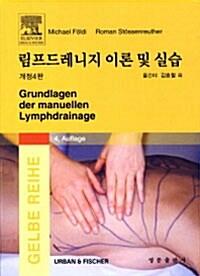


















책 이미지

책 정보
· 분류 : 외국도서 > 의학 > 내분비학/신진대사
· ISBN : 9780323030649
· 쪽수 : 120쪽
· 출판일 : 2004-10-21
책 소개
- Explains procedures in a detailed, step-by-step format.
- Features a helpful chart of lymph node groups and their tributary regions that outlines each lymph node as it pertains to a specific anatomical region.
- Key information is summarized in the margins, making it easier for readers to review what they've read and focus on important topics.
- Self-test questions provide an excellent means for readers to assess their comprehension and review key material in the book. These questions are also helpful in preparing for exams.
- Two-color illustrations help the reader visualize and learn theoretical aspects of this therapy.
- The text has been completely updated to reflect the latest techniques in lymph drainage therapy.
- Coverage of individual treatment strokes and stroke sequences have been updated, with more comprehensive descriptions and detailed photos that illustrate proper hand placement, pressure, and movement.
- Expanded coverage of complete decongestive therapy, including a CDT survey ? consisting of the case history, examination, and palpation ? that can be used to gather valuable information to formulate therapeutic goals and evaluate treatment results.
Reviews
"This book aims to describe the scientific principles that underline manual lymph drainage.""Treatment strokes and stroke sequences are then described for specific body areas, as well as hand placement, pressure and movement. These chapters, indeed the whole book, are extensively illustrated with photos and/or illustrations on nearly every page."
Matthew Boylan. Journal of the Australian Traditional-Medicine Society, June 2006
목차
1. Anatomy of the Lymph Vessel System
1.1 The Lymph Vessel System
1.2 Lymph Nodes and Lymphatic Regions
1.3 Important Lymph Node Groups and Their Tributary Regions
2. Interstitial Fluid and Lymph
2.1 Blood and Tissue Fluid Exchange
2.2 Circulation of Protein Molecules
3. Lymph Formation and Lymph Flow: “Physiological Lymph Drainage?
3.1 Lymph Formation
3.2 Lymph Transport
3.3 The Lymphatic System’s Safety Valve Function
4. Lymphatic System Insufficiency
4.1 High Volume Insufficiency or “Dynamic Insufficiency?
4.2 Low Volume Insufficiency or “Mechanical Insufficiency?
4.3 Safety Valve Insufficiency
5. The Effect of Massage Upon Lymph Formation and the Lymphangiomotor Function 5.1 Manual Lymph Drainage and Lymph Formation
5.2 Manual Lymph Drainage and Lymphangiomotor Function
6. Basic Principles of Manual Lymph Drainage
6.1 Massage Strokes
6.2 Performing Manual Lymph Drainage
6.3 Indications and Contraindications of Manual Lymph Drainage
(MLD) and Complete Decongestive Therapy (CDT)
6.4 Massage Stroke Sequences for Different Treatment Areas
7. Treatment of Cervical Lymph Nodes and Their Tributary Regions
7.1 Anatomical Foundations
7.2 Treatment of the Neck and Shoulder Areas
7.3 Treatment of the Back of the Head and the Nape of the Neck
7.4 Treatment of the Face
7.5 Oral Cavity Drainage
8. Treatment of Axillary Lymph Nodes and Their Tributary Regions
8.1 Anatomical Foundations
8.2 Treatment of the Breast
8.3 Treatment of the Back
8.4 Treatment of the Arm
9. Treatment of the Large, Deep Lymphatic Trunks
9.1 Anatomical Foundations
9.2 Treatment of the Abdomen
9.3 Alternative Massage Strokes for Abdominal Drainage
10. Treatment of Inguinal Lymph Nodes and Their Tributary Regions
10.1 Anatomical Foundations
10.2 Treatment of the Inguinal Lymph Nodes
10.3 Treatment of the Abdominal Wall
10.4 Treatment of the Lumbar Region
10.5 Treatment of the Leg
11. Complete Decongestive Therapy ? CDT
11.1 General
11.2 How Compression Therapy Works
11.3 Diagnostic Survey
11.4 Further Physical Therapeutic Measures Within the CDT the Framework
Index