

















책 이미지

eBook 미리보기
책 정보
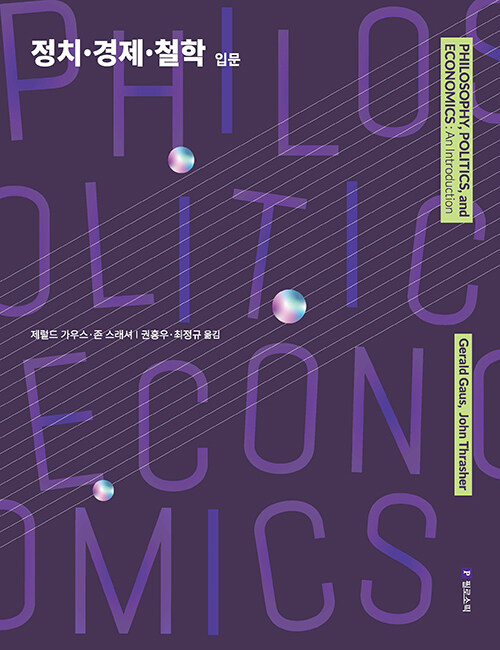
· 제목 : Philosophy, Politics, and Economics: An Introduction (Paperback)
· 분류 : 외국도서 > 인문/사회 > 철학 > 정치철학
· ISBN : 9780691219790
· 쪽수 : 338쪽
· 출판일 : 2021-11-16
· 분류 : 외국도서 > 인문/사회 > 철학 > 정치철학
· ISBN : 9780691219790
· 쪽수 : 338쪽
· 출판일 : 2021-11-16
목차
- Preface
- Introduction
- 1 Rationality
- Rationality and Choice
- What Is Rationality?
- Rationality as Effectiveness
- Subjective Rationality
- Rationality and Sound Belief
- Rational Belief and Choice
- Rationality and Goals
- Actions and Goals
- From Rational Choice to Homo Economicus
- Optimizing—More Is Better than Less
- Decreasing Marginal Value
- The Law of Demand—Downward Sloping Demand Curves
- Self-Interest
- Constrained Maximization
- Conclusion
- Discussion Questions
- 2 Ordinal Utility Theory
- Building Blocks
- Preferences
- Preferences as Tastes or Desires
- Revealed Preferences: The Behavioral Interpretation
- Deliberation, Actions, and Outcomes
- Actions and Outcomes
- Preferences Over Actions
- Ordinal Utility Theory
- Why Accept the Axioms?
- Conclusion
- Discussion Questions
- 3 Cardinal Utility
- Cardinal Utility
- Generating Cardinal Utilities
- Representation of Utility
- Interpersonal Comparisons
- Expected Utility
- Questioning the Axioms
- Continuity
- Better Prizes
- The Allais Paradox
- The Ellsberg Paradox
- Prospect Theory
- Psychology and Expected Utility Theory
- Errors in Probability Judgments
- Framing Effects
- Endowment Effects
- Do These Findings Undermine Expected Utility Theory?
- The Relation Between Utility Theory and Rationality
- Rationality and Maximizing Utility
- Conclusion
- Discussion Questions
- Cardinal Utility
- 4 Efficiency and Contract
- Rationality and Efficiency
- Exchange and the Edgeworth Box
- Problems with Pareto Efficiency
- Indeterminacy
- Path-Dependence
- Conflicts Between Efficiency and Rationality
- Efficiency and Welfare
- Markets and Efficiency
- Externalities
- Compensation and Kaldor-Hicks Efficiency
- Welfare, Rights, and the Liberal Paradox
- Property Rights
- Using Rights to Define Externalities
- The Coase Theorem
- Public Goods
- Non-Excludability and the Free-Rider Problem
- Non-Rival Consumption
- Public Goods and State Action
- Homo Economicus or Voluntary Cooperation?
- Conclusion
- Discussion Questions
- 5 Foundations of Game Theory
- Strategic Rationality
- Zero-Sum Games
- Extensive Form Zero-Sum Games
- The Prisoner’s Dilemma
- Rationality and Efficiency
- Public Goods and the Prisoner’s Dilemma
- Coordination Games
- Chicken
- Stag Hunt
- Battle of the Sexes
- Dominance and Rationalizability
- Mixed Strategies
- The Nash Existence Theorem
- Mixed Strategies in a Coordination Game
- Do People Play Nash?
- Subgame Perfection and Backwards Induction
- The Farmer’s Game
- Two Kidnappers
- Backwards Induction
- Gauthier’s Solution
- Nuclear Deterrence
- Commitment
- Conclusion
- Discussion Questions
- 6 Advanced Topics in Game Theory
- Repeated Games
- Tit-for-Tat and the Evolution of Cooperation
- The Folk Theorem
- The Evolution of Direct Reciprocity
- Evolutionary Games
- Hawk-Dove Game
- Evolutionary Stable Strategies
- Asymmetries and the Origin of Property Rights
- Polymorphic Equilibria
- ESS and Nash
- Evolutionary Game Theory and Rationality
- Signaling
- Bargaining Theory
- Conclusion
- Discussion Questions
- Repeated Games
- 7 Conventions, Norms, and Institutions
- Conventions
- Conventions and Coordination
- How Do Conventions Emerge?
- Common Knowledge
- Conventions and Arbitrariness
- Convention and Contract
- Social Norms
- What Norms Do
- Norms and Cooperation
- Norms and Nash
- Bad Norms
- Institutions
- Two Types of Institutions
- Institutions and Transaction Costs
- Conclusion
- Discussion Questions
- Conventions
- 8 Social Choice Theory
- The Problem of Social Choice
- Social Choice Theory
- Collective Rationality
- May’s Theorem and Majority Rule
- May’s Conditions
- May’s Argument
- Arrow’s Theorem
- Condorcet Voting and Its Paradox
- Arrow’s Conditions
- The First Stage of the Theorem: From Local Semi-Decisiveness to Global Decisiveness
- The Second Stage of the Theorem: Finding the Dictator
- Representation and Coherence
- The Importance of Arrow’s Theorem
- Does Arrow’s Theorem Challenge Democracy?
- Dimensionality
- Collective Choice Rules
- Problems of Collective Choice Rules
- Extending Social Choice Rules
- Condorcet Method
- A Weakly Positional Method: Plurality
- A Strongly Positional Method: Borda Count
- Cardinal Methods
- Elimination Methods
- What to Choose?
- Path Dependency and Agenda Manipulation
- Path Dependency in Legislation
- Agenda Control in the Flying Club
- Strategic Voting
- Other Examples of Strategic Voting
- Logrolling: Vote Trading in Legislatures
- The Gibbard-Satterthwaite Theorem
- Conclusion
- Discussion Questions
- 9 Public Choice and Democracy
- Basic Spatial Model of Democracy
- Uncertainty and Ideology
- The Simple Spatial Model
- Complicating the Basic Spatial Model
- The Plurality Rule and the Two-Party System
- Choosing the Rules
- Unanimity
- Bicameralism
- Logrolling and Making Everyone Worse Off
- Intertemporal Coalitions
- Homo Economicus and the Symmetry Assumption
- Voting and Rationality
- Non-Electoral Utility
- The Act and Expression of Voting
- Conclusion
- Discussion Questions
- Basic Spatial Model of Democracy
- Bibliography
- Index