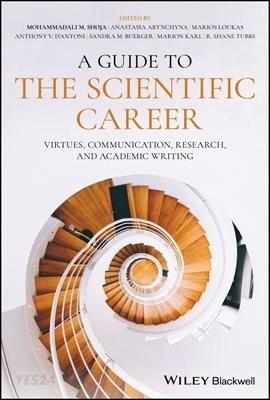


















책 이미지

책 정보
· 분류 : 외국도서 > 의학 > 내과학
· ISBN : 9781118907429
· 쪽수 : 792쪽
· 출판일 : 2019-12-16
목차
Foreword (by W. Jerry Oakes)
Preface (by Mohammadali M. Shoja, Anastasia Arynchyna, R. Shane Tubbs)
PART I: STEPS TO SUCCESS AND SUCCESSFUL PUBLICATION
Section I: Successful career
- Defining the success
- Principles of success in academia: creativity, dedication, diligence, knowledge and approachability
(Authors: Mohammadali M. Shoja, R. Shane Tubbs) - Why to write and publish in academia: Does it translate into a successful career?
(Author: Bradley K. Weiner) - A good researcher is a good academic writer (Author: Shane Tubbs)
- How to start in academic research and medical writing and how to master the art: Read, learn and practice (Author: Mohammadali M. Shoja)
- Beginner's anxiety: How it may affect your career and ways to get over it (Author:)
- The mentor-student relationship and value of an inspiring mentor (Author: Jeffrey Blount)
- Academic manners (Author: R. Shane Tubbs)
- A scientific and critical mind
- 10. Creativity and novel hypotheses (Author: Anthony V. D'Antoni)
- Approachability: manifestations, how it may affect your academic career and the way to be more
approachable (Author: Scott Ginsberg) - Responsiveness, accountability and dependability
- Emotional intelligence: its role in your professional and academic careers (Author: Rachel Russell)
- How to do deal with a manipulative person (Author: George Simon)
- Professional and academic networking (Author: Allenoush Hayrapetian)
- Time management and prioritization (Author: Lisa Hill)
- Confidence and its impact on your aspiring career (Author: Betsy Hopson)
- Personal branding
- Science is hot! (Author: Sivakumar Gowder)
- Career satisfaction and its determinants (Author: Nihal Apaydin)
- Essence of the collaborative research: leadership and engaging others, cooperativeness and getting engaged
Section II: Good paper
22. Writing for your audience
23. Writing a good paper: simplicity, focus, correct grammar/punctuation, and appropriate style and structure (Author: Jane Millward-Sadler)
24. Practical tips for good writing (Author: Mark Henderson)
25. A right title
26. A good abstract
27. Use of illustrations and figures to enhance your presentations and papers (Author: Marion Karl)
28. The art of organizing your content
29. Economy of writing: how to write technical content
30. Resources and databases: how to access them (Author: Koichi Watanabe)
31. Deciphering the quality and validity of your resources
32. Referencing software
Section III: Ethical topics
33. Academic integrity (Author: Mohammadali M. Shoja)
34. Honesty and truth in academic medical writing (Author: Thomas F. Lüscher)
35. Writing and scientific misconduct: ethical and legal aspects (Author: Marcoen Cabbolet)
36. How to deal with scientific fraud: Personal responsibilities (Author: Bradley K. Weiner)
37. Plagiarism: how to avoid it (Author: Izet Masic)
38. Gender disparity in the medical research (Authors: Jean Anderson Eloy, Peter Svider)
Section IV: Business related topics
39. Conflict of interest: A simple explanation (Author: Bradley K. Weiner)
40. Why is it important to disclose sources of financial support? (Author: Caroline Watson)
41. Essentials of grant application and proposal writing
Section V: Content review
42. Institutional review board: general regulations, institutional obligations and personal responsibility (Author: Anastasia Arynchyna)
43. Peer-reviewing (Author: Christoph J. Griessenauer)
44. Dealing with reviewers and peer-review comments (Author: Mohammadali M. Shoja)
45. Causes of manuscript rejection and how to handle a rejected manuscript
Section VI: Statistical analysis
46. Statistical analysis of data: Who should do it? (Authors: Mohammadali M. Shoja, R. Shane Tubbs)
47. Basic statistical analysis: What are Statistics and why are they important? (Author:)
48. Meta-analysis (Author: Anthony V. D’Antoni, Loretta Cacace)
49. Missing values: how to deal appropriately with them (Authors: Mohammadali M. Shoja, R. Shane Tubbs)
Section VII: Publication
50. Authorship (Author: Stephen W. Carmichael)
51. Types of article (Authors: Iraj Derakhshan)
52. Commissioned versus non-commissioned articles
53. Copyright (Author: E. Ralee’ Bishop)
54. Open-access publication (Author: Jeffrey Beall)
55. Biomedical journals: scientific quality, reputation and impact factor (Author: Andrew Plume)
56. How to find a suitable journal for your manuscript (Author: Stephen W. Carmichael)
57. A publisher’s perspective
58. Curriculum vitae writing guide
Part II: Good research
59. My first retrospective study - a roadmap with a 10-point plan for a basic retrospective study (Author: Philipp Hendrix)
60. Clinical research methods and designs
61. Clinical trials
62. Animal (experimental) studies
PART III: TYPES OF PUBLICATIONS
Section VIII: Reviews of literature
63. Why literature reviews are important (Author: Mohammadali M. Shoja)
64. How to identify a timely and relevant topic for a literature review
65. A guideline for conducting the systematic review: what is it and how does it differ from a conventional literature review? (Author:)
66. The structure of a literature review
Section IX: Original research articles
67. Structure of original research articles
68. Write an effective discussion for a research article
69. Discussing study limitations in a research article
Section X: Case reports
70. Clinicians are rich sources for unique medical or surgical cases (Author: Jane Millward-Sadler)
71. Ethical considerations: Patients and institutions (Author: Jane Millward-Sadler)
72. Structure of a clinical case report (Author: Jane Millward-Sadler)
73. Where to publish a case report (Author: Jane Millward-Sadler)
Section XI: Historical articles
74. Why is the history of medicine and biology important? (Author: Paul S. Agutter)
75. Types of historical articles (Author: Anand N. Bosmia, Mohammadali M. Shoja)
76. A simple guideline for writing historical articles (Author: Anand N. Bosmia, Mohammadali M. Shoja)
77. Where to submit a historical article (Author: Anand N. Bosmia, Mohammadali M. Shoja)
Section XII: Short communications or brief reports
78. How does a short communication or brief report differ from an original research article?
Section XIII: Editorials
79. What is an editorial? (Author:)
80. Who can write an editorial? (Author:)
81. Contents of a typical editorial (Author:)
Section XIV: Letters to the editor
82. Different types of letters to the editor
83. Content of a letter to the editor
Section XV: Clinical management guidelines
84. What is a clinical guideline and why is it significant? (Authors: John R.W. Kestle, Vijay Ravindra, Jay Riva-Cambrin)
85. How to initiate and standardize a clinical guideline? (Authors: John R.W. Kestle, Vijay Ravindra, Jay Riva-Cambrin)
86. Structure and content of a clinical guideline (Authors: John R.W. Kestle, Vijay Ravindra, Jay Riva-Cambrin)
PART III: ROLE MODELS
Section XVI: Selected personal stories: great researchers, fascinating writers, inspiring mentors and extraordinary clinicians/scientists
Edzard W. Ernst (Peninsula Medical School, Universities of Exeter and Plymouth, Complementary Medicine, Plymouth, United Kingdom): Edzard.Ernst@pms.ac.uk
Robert F. Spetzler
James I. Ausman (UCLA School of Medicine, Department of Neurosurgery, Los Angeles, United States)
Edward R. Laws (Harvard University, Department of Neurosurgery, Cambridge, United States)
Michael L.J. Apuzzo (USC School of Medicine, Department of Neurological Surgery, Los Angeles, United States)
Albert F. Hofman (Erasmus University Rotterdam, Department of Epidemiology, Rotterdam, Netherlands)
Keizo Sugimachi (Kyushu University, Department of Surgery and Science, Fukuoka, Japan)
Robert M. Califf (Duke University School of Medicine, Duke Translational Medicine Institute, Durham, United States)
Nancy E. Mealy (Prous Science, Barcelona, Spain)