

















책 이미지

eBook 미리보기
책 정보
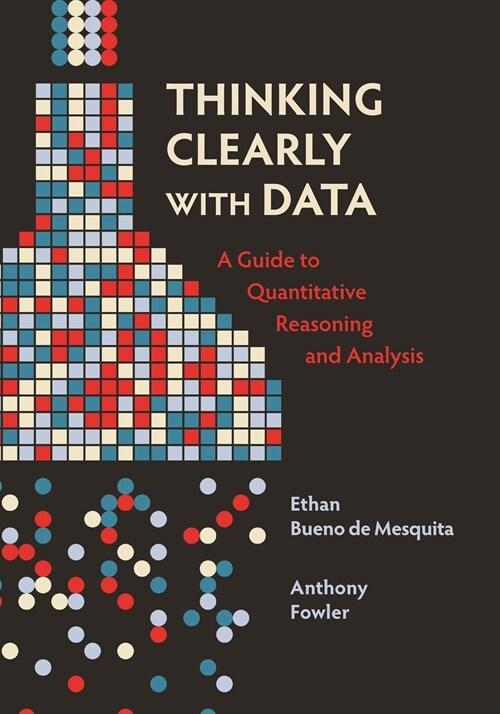
· 제목 : Thinking Clearly with Data: A Guide to Quantitative Reasoning and Analysis (Hardcover)
· 분류 : 외국도서 > 인문/사회 > 사회과학 > 방법론
· ISBN : 9780691214368
· 쪽수 : 400쪽
· 출판일 : 2021-11-16
· 분류 : 외국도서 > 인문/사회 > 사회과학 > 방법론
· ISBN : 9780691214368
· 쪽수 : 400쪽
· 출판일 : 2021-11-16
목차
- Preface
- Organization
- Who Is This Book For?
- Acknowledgments
- CHAPTER 1 Thinking Clearly in a Data-Driven Age
- What You’ll Learn
- Introduction
- Cautionary Tales
- Abe’s hasty diagnosis
- Civil resistance
- Broken-windows policing
- Thinking and Data Are Complements, Not Substitutes
- Readings and References
- PART I ESTABLISHING A COMMON LANGUAGE
- CHAPTER 2 Correlation: What Is It and What Is It Good For?
- What You’ll Learn
- Introduction
- What Is a Correlation?
- Fact or correlation?
- What Is a Correlation Good For?
- Description
- Forecasting
- Causal inference
- Measuring Correlations
- Mean, variance, and standard deviation
- Covariance
- Correlation coefficient
- Slope of the regression line
- Populations and samples
- Straight Talk about Linearity
- Wrapping Up
- Key Terms
- Exercises
- Readings and References
- CHAPTER 3 Causation: What Is It and What Is It Good For?
- What You’ll Learn
- Introduction
- What Is Causation?
- Potential Outcomes and Counterfactuals
- What Is Causation Good For?
- The Fundamental Problem of Causal Inference
- Conceptual Issues
- What is the cause?
- Causality and counterexamples
- Causality and the law
- Can causality run backward in time?
- Does causality require a physical connection?
- Causation need not imply correlation
- Wrapping Up
- Key Terms
- Exercises
- Readings and References
- CHAPTER 2 Correlation: What Is It and What Is It Good For?
- PART II DOES A RELATIONSHIP EXIST?
- CHAPTER 4 Correlation Requires Variation
- What You’ll Learn
- Introduction
- Selecting on the Dependent Variable
- The 10,000-hour rule
- Corrupting the youth
- High school dropouts
- Suicide attacks
- The World Is Organized to Make Us Select on the Dependent Variable
- Doctors mostly see sick people
- Post-mortems
- The Challenger disaster
- The financial crisis of 2008
- Life advice
- Wrapping Up
- Key Term
- Exercises
- Readings and References
- CHAPTER 5 Regression for Describing and Forecasting
- What You’ll Learn
- Introduction
- Regression Basics
- Linear Regression, Non-Linear Data
- The Problem of Overfitting
- Forecasting presidential elections
- How Regression Is Presented
- A Brief Intellectual History of Regression
- Wrapping Up
- Key Terms
- Exercises
- Readings and References
- CHAPTER 6 Samples, Uncertainty, and Statistical Inference
- What You’ll Learn
- Introduction
- Estimation
- Why Do Estimates Differ from Estimands?
- Bias
- Noise
- What Makes for a Good Estimator?
- Quantifying Precision
- Standard errors
- Small samples and extreme observations
- Confidence intervals
- Statistical Inference and Hypothesis Testing
- Hypothesis testing
- Statistical significance
- Statistical Inference about Relationships
- What If We Have Data for the Whole Population?
- Substantive versus Statistical Significance
- Social media and voting
- The Second Reform Act
- Wrapping Up
- Key Terms
- Exercises
- Readings and References
- CHAPTER 7 Over-Comparing, Under-Reporting
- What You’ll Learn
- Introduction
- Can an octopus be a soccer expert?
- Publication Bias
- p-hacking
- p-screening
- Are Most Scientific “Facts” False?
- ESP
- Get out the vote
- p-hacking forensics
- Potential Solutions
- Reduce the significance threshold
- Adjust p-values for multiple testing
- Don’t obsess over statistical significance
- Pre-registration
- Requiring pre-registration in drug trials
- Replication
- Football and elections
- Test important and plausible hypotheses
- The power pose
- Beyond Science
- Superstars
- Wrapping Up
- Key Terms
- Exercises
- Readings and References
- CHAPTER 8 Reversion to the Mean
- What You’ll Learn
- Introduction
- Does the truth wear off?
- Francis Galton and Regression to Mediocrity
- Reversion to the Mean Is Not a Gravitational Force
- Seeking Help
- Does knee surgery work?
- Reversion to the Mean, the Placebo Effect, and Cosmic Habituation
- The placebo effect
- Cosmic habituation explained
- Cosmic habituation and genetics
- Beliefs Don’t Revert to the Mean
- Wrapping Up
- Key Words
- Exercises
- Readings and References
- CHAPTER 4 Correlation Requires Variation
- PART III IS THE RELATIONSHIP CAUSAL?
- CHAPTER 9 Why Correlation Doesn’t Imply Causation
- What You’ll Learn
- Introduction
- Charter schools
- Thinking Clearly about Potential Outcomes
- Sources of Bias
- Confounders
- Reverse causality
- The 10,000-hour rule, revisited
- Diet soda
- How Different Are Confounders and Reverse Causality?
- Campaign spending
- Signing the Bias
- Contraception and HIV
- Mechanisms versus Confounders
- Thinking Clearly about Bias and Noise
- Wrapping Up
- Key Terms
- Exercises
- Readings and References
- CHAPTER 10 Controlling for Confounders
- What You’ll Learn
- Introduction
- Party whipping in Congress
- A note on heterogeneous treatment effects
- The Anatomy of a Regression
- How Does Regression Control?
- Controlling and Causation
- Is social media bad for you?
- Reading a Regression Table
- Controlling for Confounders versus Mechanisms
- There Is No Magic
- Wrapping Up
- Key Terms
- Exercises
- Readings and References
- CHAPTER 11 Randomized Experiments
- What You’ll Learn
- Introduction
- Breastfeeding
- Randomization and Causal Inference
- Estimation and Inference in Experiments
- Standard errors
- Hypothesis testing
- Problems That Can Arise with Experiments
- Noncompliance and instrumental variables
- Chance imbalance
- Lack of statistical power
- Attrition
- Interference
- Natural Experiments
- Military service and future earnings
- Wrapping Up
- Key Terms
- Exercises
- Readings and References
- CHAPTER 12 Regression Discontinuity Designs
- What You’ll Learn
- Introduction
- How to Implement an RD Design
- Are extremists or moderates more electable?
- Continuity at the Threshold
- Does continuity hold in election RD designs?
- Noncompliance and the Fuzzy RD
- Bombing in Vietnam
- Motivation and Success
- Wrapping Up
- Key Terms
- Exercises
- Readings and References
- CHAPTER 13 Difference-in-Differences Designs
- What You’ll Learn
- Introduction
- Parallel Trends
- Two Units and Two Periods
- Unemployment and the minimum wage
- N Units and Two Periods
- Is watching TV bad for kids?
- N Units and N Periods
- Contraception and the gender-wage gap
- Useful Diagnostics
- Do newspaper endorsements affect voting decisions?
- Is obesity contagious?
- Difference-in-Differences as Gut Check
- The democratic peace
- Wrapping Up
- Key Terms
- Exercises
- Readings and References
- CHAPTER 14 Assessing Mechanisms
- What You’ll Learn
- Introduction
- Causal Mediation Analysis
- Intermediate Outcomes
- Cognitive behavioral therapy and at-risk youths in Liberia
- Independent Theoretical Predictions
- Do voters discriminate against women?
- Testing Mechanisms by Design
- Social pressure and voting
- Disentangling Mechanisms
- Commodity price shocks and violent conflict
- Wrapping Up
- Key Terms
- Exercises
- Readings and References
- CHAPTER 9 Why Correlation Doesn’t Imply Causation
- PART IV FROM INFORMATION TO DECISIONS
- CHAPTER 15 Turn Statistics into Substance
- What You’ll Learn
- Introduction
- What’s the Right Scale?
- Miles-per-gallon versus gallons-per-mile
- Percent versus percentage point
- Visual Presentations of Data
- Policy preferences and the Southern realignment
- Some rules of thumb for data visualization
- From Statistics to Beliefs: Bayes’ Rule
- Bayes’ rule
- Information, beliefs, priors, and posteriors
- Abe’s celiac revisited
- Finding terrorists in an airport
- Bayes’ rule and quantitative analysis
- Expected Costs and Benefits
- Screening frequently or accurately
- Wrapping Up
- Key Words
- Exercises
- Readings and References
- CHAPTER 16 Measure Your Mission
- What You’ll Learn
- Introduction
- Measuring the Wrong Outcome or Treatment
- Partial measures
- Metal detectors in airports
- Intermediate outcomes
- Blood pressure and heart attacks
- Ill-defined missions
- Climate change and economic productivity
- Partial measures
- Do You Have the Right Sample?
- External validity
- Malnutrition in India and Bangladesh
- Selected samples
- College admissions
- Why can’t major league pitchers hit?
- External validity
- Strategic Adaptation and Changing Relationships
- The duty on lights and windows
- The shift in baseball
- The war on drugs
- Wrapping Up
- Key Words
- Exercises
- Readings and References
- CHAPTER 17 On the Limits of Quantification
- What You’ll Learn
- Introduction
- Decisions When Evidence Is Limited
- Cost-benefit analysis and environmental regulation
- Floss your teeth and wear a mask
- Floss your teeth
- Wear a mask
- Quantification and Values
- How quantitative tools sneak in values
- Algorithms and racial bias in health care
- How quantification shapes our values
- How quantitative tools sneak in values
- Think Clearly and Help Others Do So Too
- Exercises
- Readings and References
- CHAPTER 15 Turn Statistics into Substance
- Index