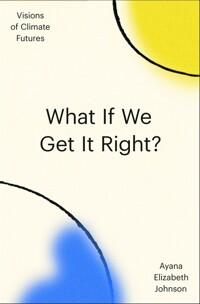


















책 이미지

eBook 미리보기
책 정보
· 제목 : What If We Get It Right?: Visions of Climate Futures (Paperback)
· 분류 : 외국도서 > 과학/수학/생태 > 과학 > 지구온난화/기후변화
· ISBN : 9780593229385
· 쪽수 : 544쪽
· 출판일 : 2026-04-14
· 분류 : 외국도서 > 과학/수학/생태 > 과학 > 지구온난화/기후변화
· ISBN : 9780593229385
· 쪽수 : 544쪽
· 출판일 : 2026-04-14
책 소개
NEW YORK TIMES BESTSELLER • “With a thoughtfully curated series of essays, poetry, and conversations, the brilliant scientist and climate expert Ayana Elizabeth Johnson has assembled a group of dynamic people who are willing to imagine what seems impossible, and articulate those visions with enthusiastic clarity.”—Roxane Gay
Our climate future is not yet written. What if we act as if we love the future?
A SMITHSONIAN BEST BOOK OF THE YEAR
Sometimes the bravest thing we can do while facing an existential crisis is imagine life on the other side. This provocative and joyous book maps an inspiring landscape of possible climate futures.
Through clear-eyed essays and vibrant conversations, infused with data, poetry, and art, Ayana Elizabeth Johnson guides us through solutions and possibilities at the nexus of science, policy, culture, and justice. Visionary farmers and financiers, architects and advocates, help us conjure a flourishing future, one worth the effort it will take—from every one of us, with whatever we have to offer—to create.
If you haven’t yet been able to picture a transformed and replenished world—or to see yourself, your loved ones, and your community in it—this book is for you. If you haven’t yet found your role in shaping this new world or you’re not sure how we can actually get there, this book is for you.
With grace, humor, and humanity, Johnson invites readers to ask and answer this ultimate question together: What if we get it right?
On possibility and transformation with:
Paola Antonelli • Xiye Bastida • Jade Begay • Wendell Berry • Régine Clément • Steve Connell • Erica Deeman • Abigail Dillen • Brian Donahue • Jean Flemma • Kelly Sims Gallagher • Rhiana Gunn-Wright • Olalekan Jeyifous • Corley Kenna • Bryan C. Lee Jr. • Franklin Leonard • Adam McKay • Bill McKibben • Kate Marvel • Samantha Montano • Kate Orff • Leah Penniman • Marge Piercy • Colette Pichon Battle • Kendra Pierre-Louis • Judith D. Schwartz • Jigar Shah • Ayisha Siddiqa • Bren Smith • Oana Stănescu • Mustafa Suleyman • Jacqueline Woodson
“This book had me at its title. Through a collection of thoughtful essays and interviews, Johnson explores the possibility of getting it right with a visionary group of environmental leaders, activists and other big thinkers working on the front lines. Johnson, who has become a prominent voice on climate solutions, reminds us that there is also joy in working toward a future where we can all thrive.”—Los Angeles Times
“This is the book we’ve been waiting for—a brilliant mix of creativity and wisdom that feels like we’re eavesdropping on intimate conversations with the world’s most brilliant change-makers. In What If We Get It Right?, Johnson weaves together art, poetry, and expert interviews into a deeply human exploration of the interconnected challenges we face. The result is a vision of a future filled with joy and possibility, where fixing one problem helps us solve many more.”—Katharine Hayhoe, climate scientist, author, and UN Champion of the Earth
“An optimistic bent and eager embrace of solutions . . . these conversations are as much about ‘getting it right’ as they are about what we are currently getting wrong. Johnson is a top-notch interviewer, and her guests are insightful and candid.”—Scientific American
“An entirely credible (and entirely enchanting) voice . . . Ayana Johnson is no Pollyanna. She’s a hard-nosed and extremely competent scientist who has not shied for a minute from facing the hard truths.”—Bill McKibben
“Rigorous, elucidating, and hopeful in the most catalytic sense, this volume will stiffen your political will and open your mind and heart. It could arrive at no better moment.”—Rebecca Traister, bestselling author and writer for New York magazine
“I believe that this is a book that the young among us have been waiting for. It is certainly the reset that we as societies and as elders owe to coming generations of humanity—and to our magnificent natural world.”—Krista Tippett, Peabody Award-winning broadcaster, a National Humanities Medalist, and a New York Times bestselling author
“The climate crisis is terrifying, but also exhilarating—exhilarating because spectacular new ideas, approaches, and values are arising to address the terrifying stuff . . . Ayana Elizabeth Johnson's fantastic new anthology lets you listen to dozens of them.”—Rebecca Solnit, author, feminist, environmentalist
“Critically, What If We Get It Right? reminds us of the most important solution of all: protecting and restoring nature, the magic of photosynthesis and water cycle. If you need a kick in the pants to roll up your sleeves on climate solutions, this book is for you.”—Yvon Chouinard, founder of Patagonia
“If you are enamored with possibility, as I am, let the perspectives gathered in these pages fill you up and propel you on. Ayana Elizabeth Johnson has prepared a genuine feast for us. Savor every ‘what if’ for our shared future.”—Dr. Katharine K. Wilkinson, co-editor of All We Can Save and lead writer of Drawdown
Note: So that we’re all on the same page about how catastrophically bad things are, how radical the change is that’s required, and how urgently we need to get it together, here’s a quick reality check. Then, after this brief wallop of bad news (this whole thing is !!!), we’ll set aside the gloom and horrors (for the most part—context is important!), and focus on “what ifs.”
At parties, usually late at night when inhibitions are long gone, people who know that I do climate work sidle up with their big question, often whispered: “So, tell me the truth, how f***ed are we?” I usually answer, “We’re pretty f***ed, but . . .” and then immediately pivot to solutions. But here I’ll lay out the dire scenario. Okay, deep breath.
The Earth is hotter now than at any other point in human history. We spew greenhouse gases (aka carbon pollution) out of more than a billion tailpipes and smokestacks, creating a dangerously insulating blanket around the planet. And measuring atmospheric temperatures actually masks the true scale of climate change, because the ocean has absorbed the vast majority of the heat—in Florida the water surpassed 100°F (37.8°C), jacuzzi temperatures. Not good. Heat waves are more frequent and last longer. Hurricanes are getting stronger and wetter. Glaciers are melting faster than expected. The massive ocean currents that regulate our climate are slowing down, screwed up by excess heat and excess fresh water—water that was recently ice. Sea level is rising—two more meters (over six feet!) of water could be coming soon to a coastline near you, displacing hundreds of millions of people.
We have changed the pH of the entire ocean. It has absorbed so much carbon dioxide (CO2) that it’s getting more acidic. That sucks for ocean creatures trying to build a shell or skeleton, or just not crumble. Plus, we hunt fish using sonar, helicopters, nets larger than football fields, and tons of fuel—most fish populations are overfished or fished to the max. Meanwhile, many animals both in the sea and on land are making a one-way migration toward the poles seeking cooler zones, while corals and trees are stuck frying and shriveling in place. The Amazon rainforest is in danger of drying out. And then there are the bulldozers and saws. Every year, an area the size of nearly 20 million football fields is deforested globally, hugely contributing to climate change and to our biodiversity crisis. We are in the process of driving one million species extinct.
Simultaneously, we are on track to have more plastic in the ocean than fish, and the remaining fish are eating plastic. There’s plastic in seafood. There’s plastic in most drinking water—and in beer! There’s plastic in blood and in breast milk. Plastic is made from fossil fuels. There’s plastic in clouds. There’s plastic in rain. There’s plastic in glaciers, and glaciers are disappearing—and along with them disappears meltwater for drinking and for crops. In springtime, which can now arrive weeks sooner, snow melts earlier and flowers bloom earlier. Asynchronies in when animals emerge and when their food emerges are throwing food webs out of whack. By 2070, one-fifth of the planet could be as scorchingly hot as the (rapidly expanding) Sahara Desert. And already, around one-quarter of humanity (mostly in poor countries) is dealing with drought, which leads to famine.
Why is all this badness happening? Humans. We are burning ancient plants and animals (aka fossil fuels, not renewable) to jet around and wear fast fashion, and build highways and skyscrapers, and heat outdoor swimming pools in autumn, and shiver inside in summer, and convert lush ecosystems into sprawling and unwalkable suburbs with silly lawns, and commute alone in our cars to jobs that do not change this reckless status quo, and manufacture things we don’t need (probably plastic things), and power the devices we’re addicted to so we can “like” posts about biodiversity loss and climate disasters, and then proceed unchanged. We are fracturing rocks deep underground—causing earthquakes and polluting drinking water—to extract fracked methane (an extra-potent greenhouse gas) to light on fire to cook our food, food that is produced by dousing the soil with chemical fertilizers (made from fossil fuel) and with poisonous pesticides (derived from fossil fuel) that have been used for chemical warfare (how’s that for a red flag). When it rains, these chemicals run from land down rivers to the sea, toxifying the water and causing low-oxygen dead zones that suffocate marine life.
We package food in plastics (and, heck, even package up water) to transport it thousands of miles, burning fossil fuels for shipping. We have thousands of plants and animals we can eat, but we cultivate just a few and in enormous monocultures so that they are susceptible to disease and drought, and we create a toxic cycle of increased pesticide use and increasingly exploitative conditions for farmworkers. And then, we throw away a third of the food we produce, which releases tons of methane as it rots in landfills. After all this, much of what we are eating is over-processed junk, which is probably making us sicker and sadder and dumber. Which is maybe why we do things like bulldoze the coastal mangroves and marshes that are the nursery for baby fish and could offer us better protection from storms than seawalls. Or maybe the “why” is just the usual greed and selfishness. Banks are after all still bankrolling all these absurdities to the tune of trillions of dollars per year. And then there’s the basic air pollution. Burning fossil fuels puts sooty particles into the air, causing lung problems and heart problems and birth defects and cancer, and almost 9 million premature deaths every year. That’s one in five deaths. Plus, as hot and wet habitat expands, so do mosquitoes and the range of diseases they carry.
To make matters even worse, when it’s hotter people get irritated and aggressive and there’s more violence. Meanwhile, the news media barely connects the dots between our changed climate, famine, unrest, war, and migration. Climate shocks are now the second-biggest cause of hunger, after conflict. Plus. our military considers climate change a “threat multiplier” that will increase the odds of wars—what a cycle. Holy hell. Unsurprisingly, inequalities are exacerbated by climate change—storms, pollution, droughts, and wildfires hit poor communities and communities of color first and worst, even though they have contributed the least to cause it all. The most brutal injustice. In the face of all this, governments and corporations are making weak-ass climate pledges (2050 is too late) and wealthy nations are not even coming through with the checks they promised to help save rainforests or help developing countries handle this onslaught.
So, yeah, it’s too late to “solve” or “stop” climate change. We have already changed the climate. We have already frayed the web of life. The greenhouse gases are out of the bag, and we don’t have a time machine. We are at the stage of figuring out how to minimize the damage, mitigate the impacts, and adapt to this unknown new world—while ensuring that those who are already marginalized and struggling aren’t placed in yet more danger. Sure, space exploration is cool and all, but 8 billion of us aren’t hopping on rockets to Mars anytime soon to frolic there for eternity. And even if we could, since we clearly haven’t learned our lesson, we’d just destroy that place too.
End litany. Exhale.
Our climate future is not yet written. What if we act as if we love the future?
A SMITHSONIAN BEST BOOK OF THE YEAR
Sometimes the bravest thing we can do while facing an existential crisis is imagine life on the other side. This provocative and joyous book maps an inspiring landscape of possible climate futures.
Through clear-eyed essays and vibrant conversations, infused with data, poetry, and art, Ayana Elizabeth Johnson guides us through solutions and possibilities at the nexus of science, policy, culture, and justice. Visionary farmers and financiers, architects and advocates, help us conjure a flourishing future, one worth the effort it will take—from every one of us, with whatever we have to offer—to create.
If you haven’t yet been able to picture a transformed and replenished world—or to see yourself, your loved ones, and your community in it—this book is for you. If you haven’t yet found your role in shaping this new world or you’re not sure how we can actually get there, this book is for you.
With grace, humor, and humanity, Johnson invites readers to ask and answer this ultimate question together: What if we get it right?
On possibility and transformation with:
Paola Antonelli • Xiye Bastida • Jade Begay • Wendell Berry • Régine Clément • Steve Connell • Erica Deeman • Abigail Dillen • Brian Donahue • Jean Flemma • Kelly Sims Gallagher • Rhiana Gunn-Wright • Olalekan Jeyifous • Corley Kenna • Bryan C. Lee Jr. • Franklin Leonard • Adam McKay • Bill McKibben • Kate Marvel • Samantha Montano • Kate Orff • Leah Penniman • Marge Piercy • Colette Pichon Battle • Kendra Pierre-Louis • Judith D. Schwartz • Jigar Shah • Ayisha Siddiqa • Bren Smith • Oana Stănescu • Mustafa Suleyman • Jacqueline Woodson
Reviews
“With a thoughtfully curated series of essays, poetry, and conversations, Johnson has assembled a group of dynamic people who are willing to imagine what seems impossible, and articulate those visions with enthusiastic clarity. The problem of climate change is a significant one, but What If We Get It Right? reminds us that with passion and ingenuity, there is so much we can accomplish.”—Roxane Gay“This book had me at its title. Through a collection of thoughtful essays and interviews, Johnson explores the possibility of getting it right with a visionary group of environmental leaders, activists and other big thinkers working on the front lines. Johnson, who has become a prominent voice on climate solutions, reminds us that there is also joy in working toward a future where we can all thrive.”—Los Angeles Times
“This is the book we’ve been waiting for—a brilliant mix of creativity and wisdom that feels like we’re eavesdropping on intimate conversations with the world’s most brilliant change-makers. In What If We Get It Right?, Johnson weaves together art, poetry, and expert interviews into a deeply human exploration of the interconnected challenges we face. The result is a vision of a future filled with joy and possibility, where fixing one problem helps us solve many more.”—Katharine Hayhoe, climate scientist, author, and UN Champion of the Earth
“An optimistic bent and eager embrace of solutions . . . these conversations are as much about ‘getting it right’ as they are about what we are currently getting wrong. Johnson is a top-notch interviewer, and her guests are insightful and candid.”—Scientific American
“An entirely credible (and entirely enchanting) voice . . . Ayana Johnson is no Pollyanna. She’s a hard-nosed and extremely competent scientist who has not shied for a minute from facing the hard truths.”—Bill McKibben
“Rigorous, elucidating, and hopeful in the most catalytic sense, this volume will stiffen your political will and open your mind and heart. It could arrive at no better moment.”—Rebecca Traister, bestselling author and writer for New York magazine
“I believe that this is a book that the young among us have been waiting for. It is certainly the reset that we as societies and as elders owe to coming generations of humanity—and to our magnificent natural world.”—Krista Tippett, Peabody Award-winning broadcaster, a National Humanities Medalist, and a New York Times bestselling author
“The climate crisis is terrifying, but also exhilarating—exhilarating because spectacular new ideas, approaches, and values are arising to address the terrifying stuff . . . Ayana Elizabeth Johnson's fantastic new anthology lets you listen to dozens of them.”—Rebecca Solnit, author, feminist, environmentalist
“Critically, What If We Get It Right? reminds us of the most important solution of all: protecting and restoring nature, the magic of photosynthesis and water cycle. If you need a kick in the pants to roll up your sleeves on climate solutions, this book is for you.”—Yvon Chouinard, founder of Patagonia
“If you are enamored with possibility, as I am, let the perspectives gathered in these pages fill you up and propel you on. Ayana Elizabeth Johnson has prepared a genuine feast for us. Savor every ‘what if’ for our shared future.”—Dr. Katharine K. Wilkinson, co-editor of All We Can Save and lead writer of Drawdown
Excerpt
Reality CheckNote: So that we’re all on the same page about how catastrophically bad things are, how radical the change is that’s required, and how urgently we need to get it together, here’s a quick reality check. Then, after this brief wallop of bad news (this whole thing is !!!), we’ll set aside the gloom and horrors (for the most part—context is important!), and focus on “what ifs.”
At parties, usually late at night when inhibitions are long gone, people who know that I do climate work sidle up with their big question, often whispered: “So, tell me the truth, how f***ed are we?” I usually answer, “We’re pretty f***ed, but . . .” and then immediately pivot to solutions. But here I’ll lay out the dire scenario. Okay, deep breath.
The Earth is hotter now than at any other point in human history. We spew greenhouse gases (aka carbon pollution) out of more than a billion tailpipes and smokestacks, creating a dangerously insulating blanket around the planet. And measuring atmospheric temperatures actually masks the true scale of climate change, because the ocean has absorbed the vast majority of the heat—in Florida the water surpassed 100°F (37.8°C), jacuzzi temperatures. Not good. Heat waves are more frequent and last longer. Hurricanes are getting stronger and wetter. Glaciers are melting faster than expected. The massive ocean currents that regulate our climate are slowing down, screwed up by excess heat and excess fresh water—water that was recently ice. Sea level is rising—two more meters (over six feet!) of water could be coming soon to a coastline near you, displacing hundreds of millions of people.
We have changed the pH of the entire ocean. It has absorbed so much carbon dioxide (CO2) that it’s getting more acidic. That sucks for ocean creatures trying to build a shell or skeleton, or just not crumble. Plus, we hunt fish using sonar, helicopters, nets larger than football fields, and tons of fuel—most fish populations are overfished or fished to the max. Meanwhile, many animals both in the sea and on land are making a one-way migration toward the poles seeking cooler zones, while corals and trees are stuck frying and shriveling in place. The Amazon rainforest is in danger of drying out. And then there are the bulldozers and saws. Every year, an area the size of nearly 20 million football fields is deforested globally, hugely contributing to climate change and to our biodiversity crisis. We are in the process of driving one million species extinct.
Simultaneously, we are on track to have more plastic in the ocean than fish, and the remaining fish are eating plastic. There’s plastic in seafood. There’s plastic in most drinking water—and in beer! There’s plastic in blood and in breast milk. Plastic is made from fossil fuels. There’s plastic in clouds. There’s plastic in rain. There’s plastic in glaciers, and glaciers are disappearing—and along with them disappears meltwater for drinking and for crops. In springtime, which can now arrive weeks sooner, snow melts earlier and flowers bloom earlier. Asynchronies in when animals emerge and when their food emerges are throwing food webs out of whack. By 2070, one-fifth of the planet could be as scorchingly hot as the (rapidly expanding) Sahara Desert. And already, around one-quarter of humanity (mostly in poor countries) is dealing with drought, which leads to famine.
Why is all this badness happening? Humans. We are burning ancient plants and animals (aka fossil fuels, not renewable) to jet around and wear fast fashion, and build highways and skyscrapers, and heat outdoor swimming pools in autumn, and shiver inside in summer, and convert lush ecosystems into sprawling and unwalkable suburbs with silly lawns, and commute alone in our cars to jobs that do not change this reckless status quo, and manufacture things we don’t need (probably plastic things), and power the devices we’re addicted to so we can “like” posts about biodiversity loss and climate disasters, and then proceed unchanged. We are fracturing rocks deep underground—causing earthquakes and polluting drinking water—to extract fracked methane (an extra-potent greenhouse gas) to light on fire to cook our food, food that is produced by dousing the soil with chemical fertilizers (made from fossil fuel) and with poisonous pesticides (derived from fossil fuel) that have been used for chemical warfare (how’s that for a red flag). When it rains, these chemicals run from land down rivers to the sea, toxifying the water and causing low-oxygen dead zones that suffocate marine life.
We package food in plastics (and, heck, even package up water) to transport it thousands of miles, burning fossil fuels for shipping. We have thousands of plants and animals we can eat, but we cultivate just a few and in enormous monocultures so that they are susceptible to disease and drought, and we create a toxic cycle of increased pesticide use and increasingly exploitative conditions for farmworkers. And then, we throw away a third of the food we produce, which releases tons of methane as it rots in landfills. After all this, much of what we are eating is over-processed junk, which is probably making us sicker and sadder and dumber. Which is maybe why we do things like bulldoze the coastal mangroves and marshes that are the nursery for baby fish and could offer us better protection from storms than seawalls. Or maybe the “why” is just the usual greed and selfishness. Banks are after all still bankrolling all these absurdities to the tune of trillions of dollars per year. And then there’s the basic air pollution. Burning fossil fuels puts sooty particles into the air, causing lung problems and heart problems and birth defects and cancer, and almost 9 million premature deaths every year. That’s one in five deaths. Plus, as hot and wet habitat expands, so do mosquitoes and the range of diseases they carry.
To make matters even worse, when it’s hotter people get irritated and aggressive and there’s more violence. Meanwhile, the news media barely connects the dots between our changed climate, famine, unrest, war, and migration. Climate shocks are now the second-biggest cause of hunger, after conflict. Plus. our military considers climate change a “threat multiplier” that will increase the odds of wars—what a cycle. Holy hell. Unsurprisingly, inequalities are exacerbated by climate change—storms, pollution, droughts, and wildfires hit poor communities and communities of color first and worst, even though they have contributed the least to cause it all. The most brutal injustice. In the face of all this, governments and corporations are making weak-ass climate pledges (2050 is too late) and wealthy nations are not even coming through with the checks they promised to help save rainforests or help developing countries handle this onslaught.
So, yeah, it’s too late to “solve” or “stop” climate change. We have already changed the climate. We have already frayed the web of life. The greenhouse gases are out of the bag, and we don’t have a time machine. We are at the stage of figuring out how to minimize the damage, mitigate the impacts, and adapt to this unknown new world—while ensuring that those who are already marginalized and struggling aren’t placed in yet more danger. Sure, space exploration is cool and all, but 8 billion of us aren’t hopping on rockets to Mars anytime soon to frolic there for eternity. And even if we could, since we clearly haven’t learned our lesson, we’d just destroy that place too.
End litany. Exhale.
About the Author
Dr. Ayana Elizabeth Johnson is a marine biologist, policy expert, writer, and Brooklyn native. She co-founded and leads Urban Ocean Lab, a think tank for the future of coastal cities, and is the Roux Distinguished Scholar at Bowdoin College. Dr. Johnson co-edited the bestselling climate anthology All We Can Save, co-created and co-hosted the Spotify/Gimlet podcast How to Save a Planet, and co-authored the Blue New Deal, a roadmap for including the ocean in climate policy. She serves on the board of directors for Patagonia and GreenWave, and on the advisory board of Environmental Voter Project. Above all: She is in love with climate solutions.