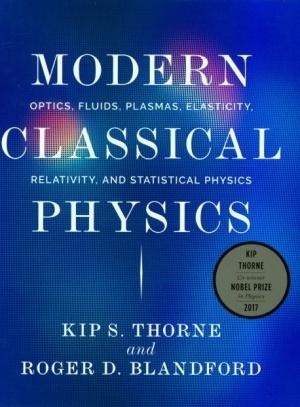


















책 이미지

eBook 미리보기
책 정보
· 제목 : Optics: Volume 2 of Modern Classical Physics (Paperback)
· 분류 : 외국도서 > 과학/수학/생태 > 과학 > 물리학 > 일반
· ISBN : 9780691207360
· 쪽수 : 272쪽
· 출판일 : 2021-06-15
· 분류 : 외국도서 > 과학/수학/생태 > 과학 > 물리학 > 일반
· ISBN : 9780691207360
· 쪽수 : 272쪽
· 출판일 : 2021-06-15
목차
- List of Boxes
- Preface
- Contents of Modern Classical Physics, volumes 1–5
- PART III OPTICS
- 7 Geometric Optics
- 7.1 Overview
- 7.2 Waves in a Homogeneous Medium
- 7.2.1 Monochromatic Plane Waves; Dispersion Relation
- 7.2.2 Wave Packets
- 7.3 Waves in an Inhomogeneous, Time-Varying Medium: The Eikonal Approximation and Geometric Optics
- 7.3.1 Geometric Optics for a Prototypical Wave Equation
- 7.3.2 Connection of Geometric Optics to Quantum Theory
- 7.3.3 Geometric Optics for a General Wave
- 7.3.4 Examples of Geometric-Optics Wave Propagation
- 7.3.5 Relation to Wave Packets; Limitations of the Eikonal Approximation and Geometric Optics
- 7.3.6 Fermat's Principle
- 7.4 Paraxial Optics
- 7.4.1 Axisymmetric, Paraxial Systems: Lenses, Mirrors, Telescopes, Microscopes, and Optical Cavities
- 7.4.2 Converging Magnetic Lens for Charged Particle Beam
- 7.5 Catastrophe Optics
- 7.5.1 Image Formation
- 7.5.2 Aberrations of Optical Instruments
- 7.6 Gravitational Lenses
- 7.6.1 Gravitational Deflection of Ligh
- 7.6.2 Optical Configuration
- 7.6.3 Microlensing
- 7.6.4 Lensing by Galaxies
- 7.7 Polarization
- 7.7.1 Polarization Vector and Its Geometric-Optics Propagation Law
- 7.7.2 Geometric Phase
- Bibliographic Note
- 8 Diffraction
- 8.1 Overview
- 8.2 Helmholtz-Kirchhoff Integral
- 8.2.1 Diffraction by an Aperture
- 8.2.2 Spreading of theWavefront: Fresnel and Fraunhofer Regions
- 8.3 Fraunhofer Diffraction
- 8.3.1 Diffraction Grating
- 8.3.2 Airy Pattern of a Circular Aperture: Hubble Space Telescope
- 8.3.3 Babinet's Principle
- 8.4 Fresnel Diffraction
- 8.4.1 Rectangular Aperture, Fresnel Integrals, and the Cornu Spiral
- 8.4.2 Unobscured PlaneWave
- 8.4.3 Fresnel Diffraction by a Straight Edge: Lunar Occultation of a Radio Source
- 8.4.4 Circular Apertures: Fresnel Zones and Zone Plates
- 8.5 Paraxial Fourier Optics
- 8.5.1 Coherent Illumination
- 8.5.2 Point-Spread Functions
- 8.5.3 Abbé's Description of Image Formation by a Thin Lens
- 8.5.4 Image Processing by a Spatial Filter in the Focal Plane of a Lens: High-Pass, Low-Pass, and Notch Filters; Phase-Contrast Microscopy
- 8.5.5 Gaussian Beams: Optical Cavities and Interferometric Gravitational-Wave Detectors
- 8.6 Diffraction at a Caustic
- Bibliographic Note
- 9 Interference and Coherence
- 9.1 Overview
- 9.2 Coherence
- 9.2.1 Young's Slits
- 9.2.2 Interference with an Extended Source: Van Cittert-Zernike Theorem
- 9.2.3 More General Formulation of Spatial Coherence; Lateral Coherence Length
- 9.2.4 Generalization to 2 Dimensions
- 9.2.5 Michelson Stellar Interferometer; Astronomical Seeing
- 9.2.6 Temporal Coherence
- 9.2.7 Michelson Interferometer and Fourier-Transform Spectroscopy
- 9.2.8 Degree of Coherence; Relation to Theory of Random Processes
- 9.3 Radio Telescopes
- 9.3.1 Two-Element Radio Interferometer
- 9.3.2 Multiple-Element Radio Interferometers
- 9.3.3 Closure Phase
- 9.3.4 Angular Resolution
- 9.4 Etalons and Fabry-Perot Interferometers
- 9.4.1 Multiple-Beam Interferometry; Etalons
- 9.4.2 Fabry-Perot Interferometer and Modes of a Fabry-Perot Cavity with Spherical Mirrors
- 9.4.3 Fabry-Perot Applications: Spectrometer, Laser, Mode-Cleaning Cavity, Beam-Shaping Cavity, PDH Laser Stabilization, Optical Frequency Comb
- 9.5 Laser Interferometer Gravitational-Wave Detectors
- 9.6 Power Correlations and Photon Statistics: Hanbury Brown and Twiss Intensity Interferometer
- Bibliographic Note
- 10 Nonlinear Optics
- 10.1 Overview
- 10.2 Lasers
- 10.2.1 Basic Principles of the Laser
- 10.2.2 Types of Lasers and Their Performances and Applications
- 10.2.3 Ti:Sapphire Mode-Locked Laser
- 10.2.4 Free Electron Laser
- 10.3 Holography
- 10.3.1 Recording a Hologram
- 10.3.2 Reconstructing the 3-Dimensional Image from a Hologram
- 10.3.3 Other Types of Holography; Applications
- 10.4 Phase-Conjugate Optics
- 10.5 Maxwell's Equations in a Nonlinear Medium; Nonlinear Dielectric Susceptibilities; Electro-Optic Effects
- 10.6 Three-Wave Mixing in Nonlinear Crystals
- 10.6.1 Resonance Conditions for Three-Wave Mixing
- 10.6.2 Three-Wave-Mixing Evolution Equations in a Medium That Is Dispersion-Free and Isotropic at Linear Order
- 10.6.3 Three-Wave Mixing in a Birefringent Crystal: Phase Matching and Evolution Equations
- 10.7 Applications of Three-Wave Mixing: Frequency Doubling, Optical Parametric Amplification, and Squeezed Light
- 10.7.1 Frequency Doubling
- 10.7.2 Optical Parametric Amplification
- 10.7.3 Degenerate Optical Parametric Amplification: Squeezed Light
- 10.8 Four-Wave Mixing in Isotropic Media
- 10.8.1 Third-Order Susceptibilities and Field Strengths
- 10.8.2 Phase Conjugation via Four-Wave Mixing in CS2 Fluid
- 10.8.3 Optical Kerr Effect and Four-Wave Mixing in an Optical Fiber
- Bibliographic Note
- References
- Name Index
- Subject Index
- Contents of the Unified Work, Modern Classical Physics
- Preface to Modern Classical Physics
- Acknowledgments for Modern Classical Physics