

























책 이미지

책 정보
· 분류 : 국내도서 > 예술/대중문화 > 디자인/공예 > 공예/도자
· ISBN : 9788997252695
· 쪽수 : 162쪽
· 출판일 : 2016-12-23
책 소개
목차
Chapter 1
Maedeup: A Historical Introduction
Definition of Maedeup 14
Characteristics of Korean Maedeup 16
Arts of Korean Maedeup 20
History of Korean Maedeup 26
Transmission of Korean Maedeup 44
Chapter 2
Preparing Maedeup
Maedeup Materials 48
Knot-crafting Tools 53
Chapter 3
Crafting Maedeup
Dorae Maedeup, Double Connection Knot 64
Yeonbong Maedeup, Lotus Bud knot, Chinese Button knot 67
Garakji Maedeup, Finger Ring Knot 70
Saengjjok Maedeup, Ginger Knot, Clover Leaf Knot 73
Gukhwa Maedeup, Chrysanthemum Knot 76
Nalgae Maedeup, Wing Knot, Double Coin Knot 80
Dongsimgyeol Maedeup, One-In-Heart Knot 83
Chapter 4
Enjoying Maedeup
Swaying: Ceremonial Maedeup 88
Hanging: Indoor Maedeup Ornaments 94
Draping: Maedeup for Pendants and Headdresses 100
Hanging: Maedeup for Personal Belongings 108
Tying: Cords for Sashes and Maedeup for Pouches 114
Adjusting: Maedeup Buttons 124
Decorating: Net Ornaments 128
In the Spotlight: Modern Maedeup 134
Appendix
Masters 152
Craft & Design Map 153
List of Artifacts and Illustrations 154
Bibliography 158
Collaborators 159
Cooperation Organizations 160
Index 161
저자소개

책속에서
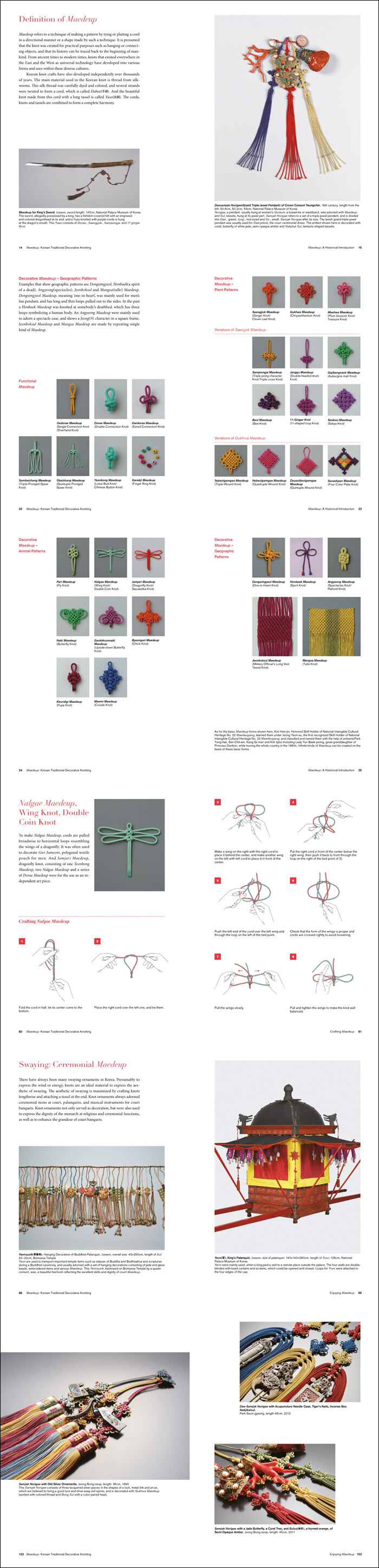
Maedeup refers to a technique of making a pattern by tying or plaiting a cord in a directional manner or a shape made by such a technique. It is presumed that the knot was created for practical purposes such as hanging or connecting objects, and that its history can be traced back to the beginning of mankind. From ancient times to modern times, knots that existed everywhere in the East and the West as universal technology have developed into various forms and uses within these diverse cultures.
Korean knot crafts have also developed independently over thousands of years. The main material used in the Korean knot is thread from silkworms. This silk thread was carefully dyed and colored, and several strands were twisted to form a cord, which is called Dahoe(多繪). And the beautiful knot made from this cord with a long tassel is called Yuso(流蘇). The cords, knots and tassels are combined to form a complete harmony.
-from.‘ Chapter 1. Maedeup: A Historical Introduction’
Examples of functional Maedeup are Oedorae Maedeup(single connection knot), Dorae Maedeup(double connection knot), Gwidorae Maedeup(eared connecton knot), Sambalchang Maedeup(three-pronged spear knot), Yeonbong Maedeup(lotus bud knot) and Garakji Maedeup(finger ring knot). Oedorae Maedeup and Dorae Maedeup are used to tie and shuffle two strands at the beginning and the end of a knot. Derived from Dorae Maedeup, Gwidorae Maedeup is a Dorae Maedeup with an ear on each side. Sambalchang Maedeup and Obalchang Maedeup are mainly used for a pouch string to decorate the lower part of the string as a tassel. Sambalchang Maedeup and Obalchang Maedeup have three and five Go, loops, hanging downward respectively. A Yeonbong Maedeup is of ambivalent characteristic: it is named from its floral appearance and accordingly decorative, but at the same time it often fulfills the function of a button. Garakji Maedeup have a shape of round marbles, are frequently knotted with cords of various colors to be inserted between knots as a decorative point, or used to conceal a joint of Maedeup cords.
-from.‘ Chapter 1. Maedeup: A Historical Introduction’
Sul, Tassels
Tassels adorn the end of a knot to enhance the swinging effect and a craftwork will look quite different depending on what style of tassel was used. Tassels made from cords are Nakjibalsul, tentacle-shaped tassel, Kkeunsul, cord tassel, Bangulsul, bell tassel, while tassels made from several strands of twisted thread are Bongsul, tassel with a coiled head, Ttalgisul, strawberry tassel, Bangmangisul, bat-shaped tassel, Hususul, tassels for hanging sash on the back, Geumjeonjisul, gold leaf tassels, Mujigaesul, rainbow tassels, and small sized tassels with a coiled head are called Jansul.
Nakjibasul is named for its resemblance to octopus(nakji). The cord is rolled several times, folded in half, then made by plaiting the middle with a cord. Based on how many Dan, bands made from the rolled up cord, are plaited, it is called single-headed, double-headed and triple-headed Nakjibalsul. It is used a lot for Daesamjak-norigae, grand triple-jewel pendants.
Kkeunsul, a cord tassel, is named because of its material ? cords. Several strands of cords are folded in half, then plaited in the middle. While similar to the process making of Nakjibalsul, it differs in that the end of the tassels are not connected but frayed. Used for bigger pendants, pouch strings and palanquin Yuso.
-from.‘ Chapter 2. Preparing Maedeup’
Tools Necessary for Plaiting Cord
Tools necessary for plaiting cord are Jaae(or Jasae), a grand reel, Jaguri, a reel, Sangsageori, a thread rack, Bitot, a weight for plaiting thread, Tojjak, a plaiting spool, and Dahoeteul, a plaiting tool.
In order to plait threads one has to begin by dyeing silk thread. The dyed silk thread is unraveled while hanging from Jaae, and then stored after being rolled up onto a Jaguri. When plaiting the thread into cords of necessary thickness, a Sangsageori and Bitot are used. The Sangsageori is laid out according to the necessary length of cord, thread is hung between it and plaited by adding as many strands until the right thickness is achieved, then twisted by hanging this thread to a Bitot. The plaited thread is rolled onto a Tojjak then fastened to a Dahoeteul to plait threads , while the number of Tojjak determines if the cord will be an 8-ply or 16-ply one, etc.
-from.‘ Chapter 2. Preparing Maedeup’


